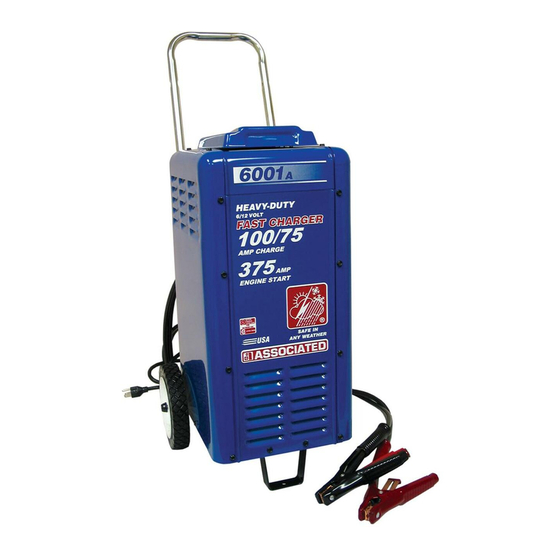
Associated 6001A Manuel De L'opérateur
Table des Matières
Les langues disponibles
Les langues disponibles
Liens rapides
ASSOCIATED
SAVE THESE INSTRUCTIONS.
1.
purchased. You may need to refer to these instructions at a later date.
2.
CAUTION.
To reduce risk of injury, charge only wet cell, lead-acid, automotive type rechargeable batteries. Other types of batteries may
burst causing personal injury and property damage.
3.
Do not expose the charger to rain or snow if specifically warned on the unit not to do so.
4.
Use of an attachment not recommended or sold by the battery charger manufacturer may result in a risk of fire, electric shock, or injury to
persons.
5.
To reduce the risk of damage to the electric plug and cord, pull by the plug rather than the cord when disconnecting the charger.
6.
Make sure the cord is located so that it will not be stepped on, tripped over, or otherwise subjected to damage or stress.
7.
An extension cord should not be used unless absolutely necessary. Use of an improper extension cord could result in a risk of fire and electric
shock. If an extension cord must be used, make sure:
a.
That the pins on the plug of extension cord are the same number, size, and shape as those of the plug on the charger;
b.
That the extension cord is properly wired and in good condition; and
c.
If the length of the extension cord is less than 25 feet, use a 16AWG cord, If 50 feet-12AWG, 100 feet-10AWG, 150 feet-8AWG.
8.
Do not operate the charger with a damaged cord or plug, replace them immediately.
9.
Do not operate the charger if it has received a sharp blow, been dropped, or otherwise damaged in any way; take it to a qualified serviceman.
10. Do not disassemble the charger unless you are qualified to work on electrical products. If not, take it to a qualified serviceman when service or
repair is required. Incorrect reassembly may result in risk of electric shock or fire.
11. To reduce the risk of electric shock, unplug the charger from the outlet before attempting any maintenance or cleaning. Turning off the
controls will not reduce this risk.
WARNING - RISK OF EXPLOSIVE GASES
12.
a.
WORKING IN VICINITY OF A LEAD-ACID BATTERY IS DANGEROUS. BATTERIES GENERATE EXPLOSIVE GASES DURING
NORMAL BATTERY OPERATION. FOR THIS REASON IT IS OF UTMOST IMPORTANCE THAT EACH TIME BEFORE USING YOUR
CHARGER, YOU READ THIS MANUAL AND FOLLOW THE INSTRUCTIONS EXACTLY.
b.
To reduce the risk of battery explosion, follow these instructions and those published by the battery manufacturer and manufacturer of
any equipment you intend to use in vicinity of the battery. Review cautionary markings on these products and on the engine.
PERSONAL PRECAUTIONS
13.
a.
Someone should be within range of your voice or close enough to come to your aid when you work near a lead-acid battery.
b.
Have plenty of fresh water and soap nearby in case battery acid contacts skin, clothing, or eyes.
c.
Wear complete eye protection, and clothing protection. Avoid touching eyes while working near battery.
d.
If battery acid contacts skin or clothing, wash immediately with soap and water. If acid enter eyes, immediately flood eyes with running
cold water for at least 10 minutes and get medical attention immediately.
e.
NEVER smoke or allow a spark or flame in vicinity of the battery or engine.
f.
Be extra cautious to reduce risk of dropping a metal tool onto the battery. It might spark or short-circuit the battery or other electrical parts
that may cause an explosion.
g.
Remove personal metal items such as rings, bracelets, necklaces, and watches when working with a lead-acid battery. A lead-acid
battery can produce a short circuit current high enough to weld a ring or the like to metal, causing a severe burn.
h.
Use this charger for charging a LEAD-ACID battery only. It is not intended to supply power to a low-voltage electrical system other than
in an automotive application. Do not use this battery charger for charging dry-cell batteries that are commonly used with home
appliances. These batteries may burst and cause injury to persons and damage to property.
i.
NEVER charge a frozen battery.
PREPARING TO CHARGE
14.
a.
If necessary to remove battery from vehicle to charge, always remove the grounded terminal from the battery first. Make sure all
accessories in the vehicle are off, so as not to cause an arc.
b.
Be sure the area around the battery is well ventilated while the battery is being charged. Gas can be forcefully blown away by using a
piece of cardboard or other non-metallic material as a fan.
c.
Clean the battery terminals. Be careful to keep corrosion from coming in contact with eyes.
d.
Add distilled water in each cell until battery acid reaches level specified by the battery manufacturer. This helps purge excessive gas
from cells. Do not overfill. For a battery without cell caps, carefully follow the manufacturer's recharging instructions.
e.
Study all battery manufacturer's specific precautions such as removing or not removing the cell caps while charging and the
recommended rates of charge.
f.
Determine voltage of the battery by referring to the car owner's manual and make sure that the output voltage selector switch is set at the
correct voltage. If the charger has adjustable charge rate, charge the battery initially at the lowest rate.
CHARGER LOCATION
15.
a.
Locate the charger as far away from the battery as the DC cables permit.
b.
Never place the charger directly above the battery being charged; gases from the battery will corrode and damage the charger.
c.
Never allow battery acid to drop on the charger when reading the specific gravity or filling battery.
d.
Do not operate the charger in a closed-in area, or restrict ventilation in any way.
e.
Do not set a battery on top of the charger.
MODEL 6001A
OPERATOR'S MANUAL
IMPORTANT SAFETY INSTRUCTIONS
This manual contains important safety and operating instructions for the battery charger you have
1
Table des Matières

Manuels Connexes pour Associated 6001A


Sommaire des Matières pour Associated 6001A
-
Page 6: Instructions De Sécurité Importantes
MODÈLE 6001A MANUEL D'UTILISATION INSTRUCTIONS DE SÉCURITÉ IMPORTANTES ASSOCIATED CONSERVER CES INSTRUCTIONS. Le présent manuel contient des instructions de sécurité et d'utilisation importantes pour l'utilisation du chargeur de batterie que vous avez acheté et qui pourront se reveler utiles ulterieurement. -
Page 7: Emplacement Du Chargeur
EMPLACEMENT DU CHARGEUR Installer le chargeur aussi loin de la batterie que les câbles c.c. le permettent. Ne jamais placer le chargeur directement au-dessus d'une batterie pendant la charge; les gaz s'échappant de la batterie peuvent corroder et endommager le chargeur. Ne jamais laisser l'acide de la batterie s'égoutter sur le chargeur pendant la lecture de densité... -
Page 8: Période De Charge
INSTRUCTIONS DE MISE À LA TERRE ET DE CONNEXION DU CORDON C.A. Le chargeur doit être mis à la masse afin de réduire le risque d'électrocution. Le chargeur est muni d'un cordon électrique pourvu d'un conducteur de mise à la terre de l'équipement et d'une fiche avec la terre. La fiche doit être branchée dans une prise adéquatement installée et mise à... - Page 9 Pousser l'essieu a travers la base, placer la roue en sens invers. Placer l'ecrou essieu dans l'essieu avec un marteau. INSTRUCTIONS D'OPERATION 6001A ATTENTION. Ce chargeur de batterie doit etre completement assemble avant etre mis en route. Faillir a ceci peut provoquer des accidents.
-
Page 10: Schéma De Câblage
LIRE ET SUIVRE TOUTES LES PRECAUTIONS DANS LE MANUAL D'INSTRUCTION AVANT D'ESSAYER DE CHARGER UNE BATTERIE SULFATEE. FAILLIR A FAIRE ATTENTION PEUT DETRUIRE CE QUE VOUS AVEZ, OU VOUS BLESSEZ OU BIEN VOUS TUEZ. POUR RECHARGER UNE BATTERIE SULFATEE. Attacher les serre joints comme indique sur le manuel d'instruction. Toujours utiliser le debit le plus faible du chargeur quand le chargeur est mis en route. - Page 16 MODEL 6001A PARTS LIST Front leg ................610864 Wheels w/nuts (2)............610553 Axle w/nuts ..............605673 Base ................605186 Transformer..............611078 Rectifier ................611073 Fan Blade ................ 610189 Fan Motor ................ 610190 AC Circuit Breaker ............610464 10. Timer ................611245 11.