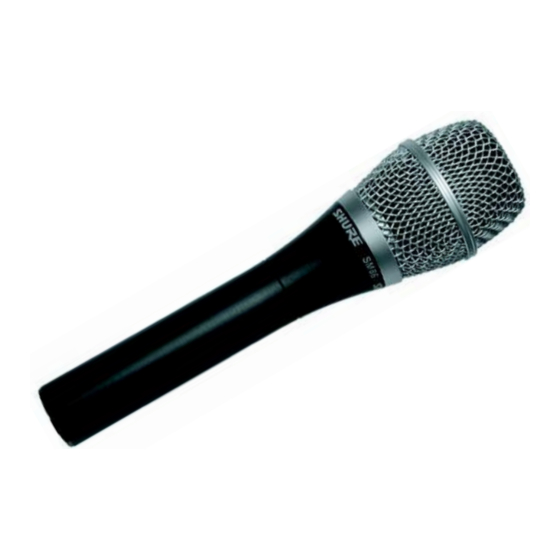
Shure SM86 Mode D'emploi
Table des Matières
Les langues disponibles
Les langues disponibles
SM86
CARDIOID CONDENSER MICROPHONE
The Shure SM86 is a unidirectional (cardioid) condenser vocal
microphone for professional use in live performance. An extremely
rugged microphone, the SM86 withstands the rigors of touring
while delivering studio-quality sound. The tailored frequency
response of the SM86 reproduces vocals with clarity. A cardioid
pickup pattern isolates the main sound source while minimizing
unwanted background noise. The built-in three-point shock mount
minimizes handling noise, and a two-stage pop fi lter reduces
wind and breath "pop" noise. The SM86 is an excellent selection
For use with both stage monitors and personal in-ear monitors.
Features:
•
Condenser cartridge for studio quality sound
•
Tailored frequency response for a clear reproduction of
vocals
•
Rugged construction withstands the rigors of touring
sound
•
Cardioid polar pattern minimizes unwanted background
noise
•
Excellent choice for stage monitors and personal in-ear
•
monitors
•
Built-in three-point shock mount minimizes handling noise
•
Two-stage "pop" fi lter reduces wind and breath noise
PROXIMITY EFFECT
Unidirectional microphones, like the SM86, progressively boost
bass frequencies up to 15 dB as the microphone gets closer to
the sound source. This phenomenon, known as proximity effect,
can be used to create a warmer, more powerful sound. To prevent
excessive or "boomy" low frequency sound during close-up use,
the SM86 bass response gradually rolls off. This provides greater
control and helps the user take advantage of proximity effect.
27B3143 (Rev. 2)
©2005, Shure Incorporated
Model SM86 User Guide
APPLICATIONS AND PLACEMENT
The SM86 is ideal for close-up vocals and can be held in the hand
or mounted on a stand. Some of the most common applications
and placement techniques are listed in the following table. Keep
in mind that microphone technique is largely a matter of personal
taste—there is no one "correct" microphone position.
SUGGESTED MICROPHONE
PLACEMENT
Lips less than 15 cm (6 in.) away or
touching the windscreen, on axis to
microphone.
15 to 60 cm (6 in. to 2 ft.) away from
mouth, just above nose Height.
More than 60 cm (2 ft.) away.
STAGE MONITOR & P.A. LOUDSPEAKERS
PLACEMENT
Place the stage monitor directly behind the microphone (see
Figure 1). Locate the P.A. loudspeakers so that they point
away from the rear of the microphone. With the speakers lo-
cated in these positions, the possibility of feedback is greatly
reduced. Always check the stage setup before a performance
to ensure optimum placement of microphone and monitors.
STAGE
MONITOR
P.A.
LOUDSPEAKERS
MICROPHONE
CARDIOID MICROPHONE POSITIONING
GENERAL RULES FOR MICROPHONE USE
1.
Aim the microphone toward the desired sound source
and away from unwanted sources.
2.
Locate the microphone as close as practical to the desired
sound source.
3.
Work close to the microphone for extra bass response.
4.
Use only one microphone per sound source.
5.
Locate microphones at least three times as far from other
microphones as from the sound source.
6.
Use as few microphones as practical.
7.
Place microphones far from sound-refl ecting surfaces.
8.
Add a windscreen when using the microphone outdoors.
9.
Avoid excessive handling to minimize mechanical noise.
TONE QUALITY
Robust sound, emphasized
bass, maximum isolation from
other sources.
Reduced bass.
Thinner, more distant sound;
noticeable levels of ambient
noise.
°
90
°
0
180
SOUND
SOURCE
°
90
FIGURE 1
Printed in U.S.A.
°
Table des Matières

Manuels Connexes pour Shure SM86


Sommaire des Matières pour Shure SM86
-
Page 3: Applications Et Placement
APPLICATIONS ET PLACEMENT Le SM86 exige une alimentation fantôme. Le microphone peut être Le SM86 est idéal pour la captation des voix en proximité et peut alimenté à partir d’un bloc d’alimentation externe (tel que le Shure être tenu à la main ou monté sur un pied. Certaines des applications modèle PS1A) ou directement à... -
Page 4: Caractéristiques Techniques
CONVERTISSEUR FILTRE AMPLIFICATEU AMPLIFICATEU AMPLIFICA VERT PROTECT. INVERS. POLARITÉ SCHÉMA DE PRINCIPE DU SM86 –10 FIGURE 4 Alimentation Tension d’alimentation fantôme 11 à 52 V c.c., positive aux 1000 10000 20000 broches 2 et 3 Consommation de courant ..... . . 5,2 mA COURBE DE RÉPONSE TYPIQUE... - Page 11 SM86 !"#$%& &' ()#*+,& !"#$ !" !"#$%& !" Shure SM86 !"#$%&'()*+ !"#$%&'()*+, P.A. !"#$# !"#$%& '()*+,-./012345 !"#$%&'()*+,-./ !"#$%&'( !"#$%&'()*+,-./01 !"#$% !"# ! "#$%&'()*+,- !"#$%&'() !"#$%&'()*3 !"#$%&'()* ! !" #$%&'()*+2 !"#$%&'#() !"#$%#&'()*+,-. !"#$( !"#$%&'SM86 !" !"#$%&%'! !()*+,-./012(0 !"#$%&'()*+, !"#$%&'()*+,-./01()23456 !"#$%&'()*+,-./01234-5 !"#$"%&'()*+,-(./0 •...